How to use PliCount
From a new game to the last deal, then the scoring rules of each game. The labels in bold are the ones of the app, in French for now.
-
Start a game
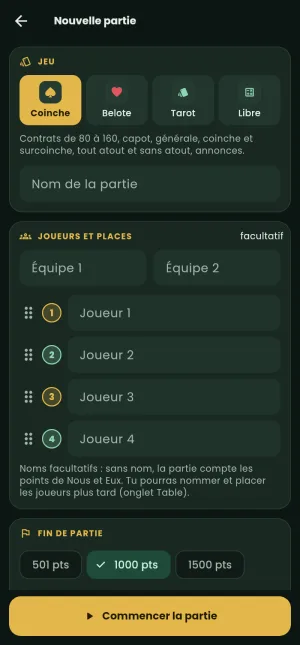
Open PliCount, tap Nouvelle partie (new game) and pick the game: coinche, belote, tarot or free scoring. Everything else is optional:
- The players, in the order of play: type their names, drag a player to move them, or draw the places at random. At the team games, the first and the third play against the second and the fourth. Without names, the players are Joueur 1 to Joueur 4 and the teams Nous and Eux (us and them).
- The direction of the deal, counterclockwise by default (the French way) or clockwise, and the first dealer: a small table shows who deals and who cuts.
- The end: a target (1000 at the coinche and the belote), a number of deals, or neither. At free scoring, the lowest total can win.
Commencer la partie (start the game) stays at the bottom of the screen: nothing needs to be typed. Partager en ligne (share online) is off by default: the game stays on the phone, and can be shared later.
-
Enter a deal
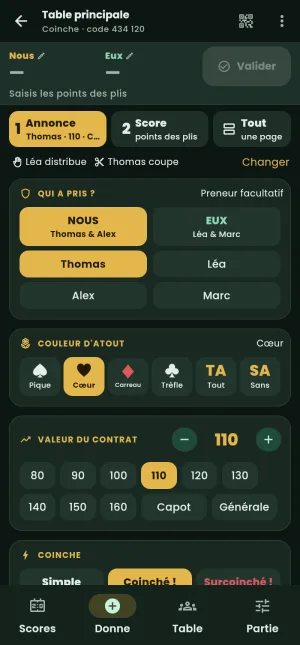
On the Scores tab, Ajouter une donne (add a deal) opens the Donne (deal) tab, in two steps at the coinche, the belote and the tarot:
- Annonce (the bid): who took, the trump, the contract, the coinche; at the tarot, the taker, the called partner at 5 and the contract. Enregistrer l'annonce (save the bid) keeps it as the deal in progress while the cards are played: on a shared game, the whole table sees it.
- Score: the card points of the taker's side (the other side gets the rest of 162, or of 91 at the tarot), the belote, the announces, the capot; at the tarot, the bouts, the petit au bout, the poignée and the chelem. Points are typed in a large dialog, the likely values ready to tap.
- Tout (all) puts the bid and the score on one page; the phone remembers the choice for the next deal.
On top, always in sight: the points of each side, how the deal ends (contract made, or down by so many points) and Valider (confirm). Tout le monde passe (everybody passes) gives the deal to the next player, nothing scored.
-
Points as they are
Counted on paper already, or a house rule? Saisie libre (free entry), on the Scores tab or by tapping a side on top of the deal, takes the points of each side as typed, with or without the bid. With a taker, the contract is made when the taker side scored more than the other one.
-
Follow the scores
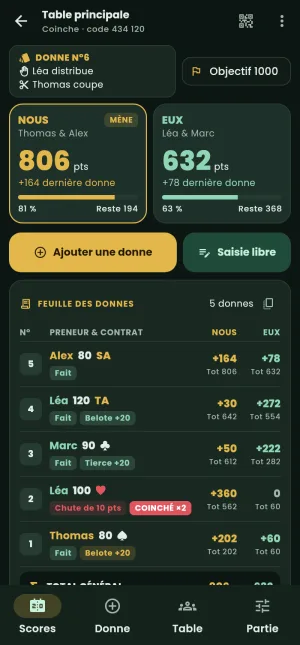
The Scores tab says who deals and who cuts, shows a card per team with its total and how far it is from the target (the ranking at the tarot and at free scoring), then the score sheet, last deal first: the taker, the contract and its trump, made or down, coinché, belote, capot, the points of each side and the running totals. Tap a deal to correct or delete it.
Once the target is reached: Victoire ! (victory), then Prolonger (play on, to a new target) or Revanche (a rematch: same players, same places, the next dealer).
-
Share the game at the table
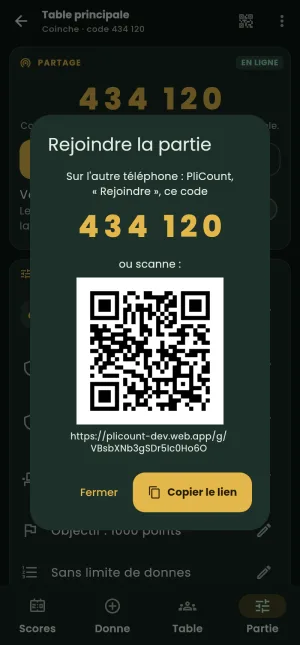
A game shared online gets a 6 digit code, valid 2 days (Nouveau code, new code, gives another one), a link and a QR code, on the Partie (game) tab. The other players open the app, tap Rejoindre une partie (join a game) and type the code, or join from here, or open the link: no account, no sign up.
- Everyone sees the scores change, and anyone can enter a deal.
- The link works as long as the game exists, after its code too.
- Its creator can Verrouiller (lock) the game, read only for the others, or delete it for everyone.
- A game started on one phone is shared later with Partager en ligne (share online): it moves to a new shared game.
-
The table
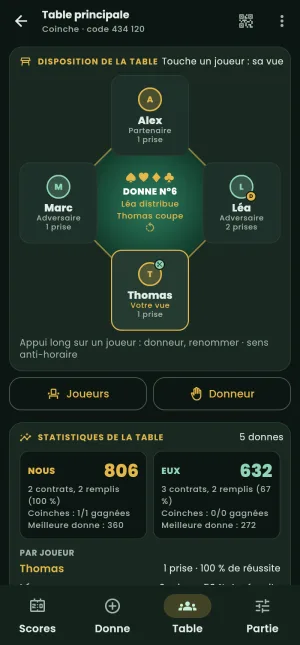
The Table tab draws the players around the felt as seen from one of them (tap a player to sit there), the dealer, the cutter and the takes of each. Joueurs (players) changes the names, the places, the direction or the next dealer at any time; changing places across the teams changes the teams, the points already scored stay where they are. Below, the statistics of the table: per team, per player and per trump.
-
Your games
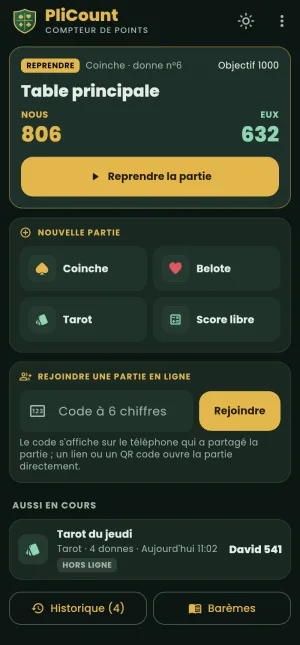
The home screen resumes the last game in one tap (Reprendre la partie, resume the game), and lists the others; the history keeps the games of the phone, in progress or over, with their final scores. The list stays on the phone: a shared game is found again with its link or its code.
The scoring rules
One set of rules per game, the common French ones; variants are not options yet. The card points of the coinche and the belote add up to 162, the last trick (dix de der) included.
Coinche
Contracts from 80 to 160, or capot (every trick); coinché counts double, surcoinché four times. The trumps: the four suits, all trumps or no trumps.
- The contract is made when the taker team has at least its contract, announces and belote included, and more than the defense; a capot contract needs every trick.
- Made: the taker team scores its card points + the contract × the multiplier + its announces; the defense its card points (none when coinché) + its announces. The belote (20) goes to the team that holds it.
- Down: the defense scores 160 + the contract × the multiplier + every announce; the taker team keeps its belote only.
- An unannounced capot counts 250 card points instead of 162.
- Announces: tierce 20, cinquante 50, cent 100, carré 100, carré de 9 150, carré de valets 200.
Example: Us take at 90 and make 112 with the belote: Us +222 (112 + 90 + 20), Them +50.
Belote
Played to 1000 by default (501 is offered), or in a number of deals.
- Made when the taker team has more than the defense, announces and belote included: each team scores its points.
- Dedans (down): the defense scores 162 + every announce.
- Litige (a tie): the taker team scores nothing, the defense its points (nothing carried over).
- Capot: 252.
Tarot
At 3, 4 or 5 players; at 5, the taker calls a king. The card points add up to 91.
- Points needed: 56, 51, 41 or 36 with 0, 1, 2 or 3 bouts.
- Contracts: petite ×1, garde ×2, garde sans ×4, garde contre ×6.
- Deal value = (25 + the difference) × the contract, ± 10 × the contract for the petit au bout (to the side that led it), ± the poignée (20, 30 or 40, to the winning side); chelem +400 announced and made, +200 made, −200 announced and failed or made by the defense.
- The taker wins or loses it against each defender: ×3 at 4 players, ×2 at 3; at 5, ×2 for the taker and ×1 for the partner (×4 alone). The scores of a deal add up to 0.
Free scoring
For any other game (Skyjo, rummy, Yahtzee...): 2 to 8 players, more can be added during the game, the points of each typed, negative ones too. A target or a number of deals ends the game; the highest total wins, or the lowest.